Manchester scientists design ‘tunable’ biomolecules to probe how sugars behave
Researchers at Manchester Institute of Biotechnology have developed a new way to precisely build and modify complex sugar molecules, creating powerful tools to study how they function in biology and disease.
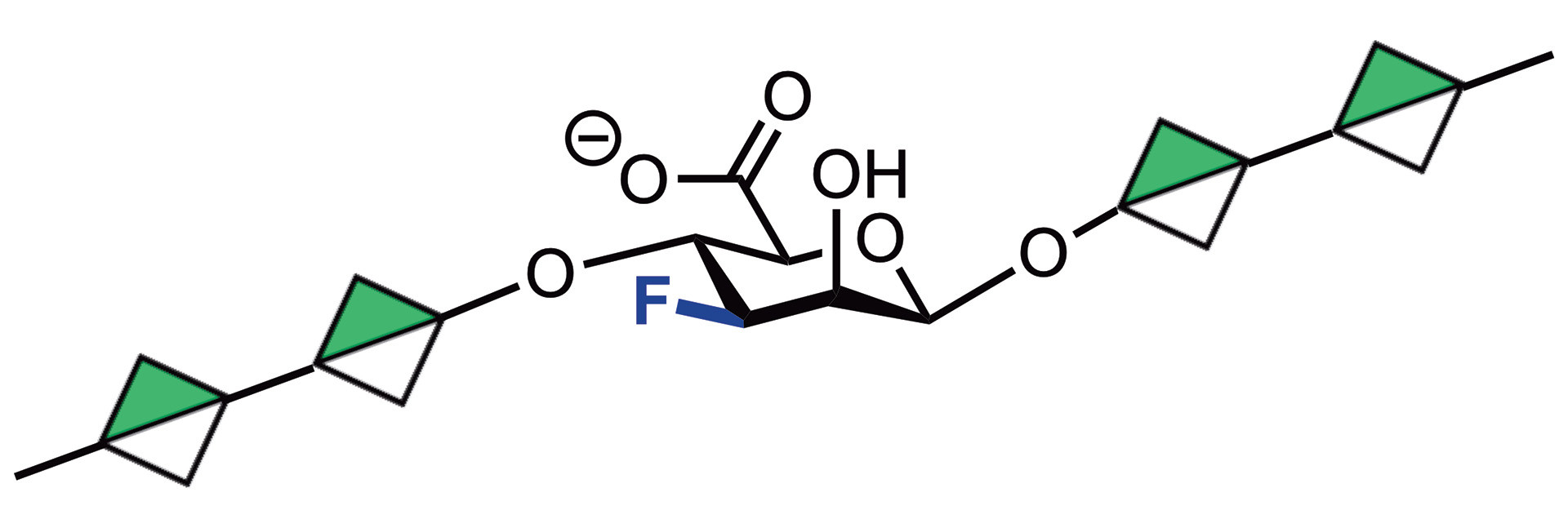
Sugars are not just a source of energy – they also play a crucial role in how cells communicate, how proteins interact and how materials behave in medicine and industry. But studying these processes is challenging because sugar molecules are structurally complex and difficult to control.
In a new study published in , the team – led by – have created modified sugar building blocks that can be assembled automatically into defined structures, enabling scientists to probe their behaviour in unprecedented detail.
The team focused on alginates – a sugar widely used as a thickener in food and as a components of wound dressings. By introducing a small chemical modification (replacing part of the molecule with fluorine), they were able to subtly alter how these sugars behave without disrupting their overall structure.
Crucially, the researchers showed that these modified building blocks can be assembled using automated synthesis – a process that allows complex molecules to be built step by step with high precision. This enabled the creation of a library of tailored sugar chains with specific modifications at defined positions.
Unlocking how structure controls function
Using advanced analytical techniques, including nuclear magnetic resonance (NMR), the team demonstrated that the modified sugars retain their overall shape, even though key internal interactions are altered.
This finding is significant because it shows that scientists can “tune� specific features of a molecule without fundamentally changing how it behaves – allowing them to isolate and study individual interactions in complex biological systems.

These modified sugars give us a way to test how specific chemical features influence how molecules fold, assemble and interact. By controlling their structure so precisely, we can start to disentangle how carbohydrates work at a molecular level.
New tools for biotechnology and medicine
The ability to design and synthesise these molecules opens up new possibilities for research and application.
Fluorinated sugars can act as sensitive “reporters�, making it easier to track interactions between molecules using spectroscopic methods. They can also help scientists better understand how enzymes process sugars – an important step in areas ranging from infection biology to materials science.
More broadly, this work lays the foundation for developing tailored carbohydrate-based materials, where structure and function can be engineered with precision.
By providing a reliable method to build and study these modified sugars, the research offers a new platform for exploring how carbohydrate structure affects behaviour – helping to bridge a long-standing gap in molecular science.
This research was published in: Angewandte Chemie - International Edition
Full title of the paper: 3-Deoxy-3-Fluoro Mannuronic Acid Alginates: Stereoselective Automated Synthesis and Conformational Behaviour
DOI: 10.1002/anie.5914227
URL: