Manchester Physicists Celebrate A Second Consecutive Year Of Success At The Breakthrough Prizes For Decades-Long Muon Experiment
The University of Manchester is celebrating a second consecutive year of success at the Breakthrough Prizes, with Manchester physicists again recognised for their leadership in one of the most ambitious and long鈥憆unning experiments in particle physics.
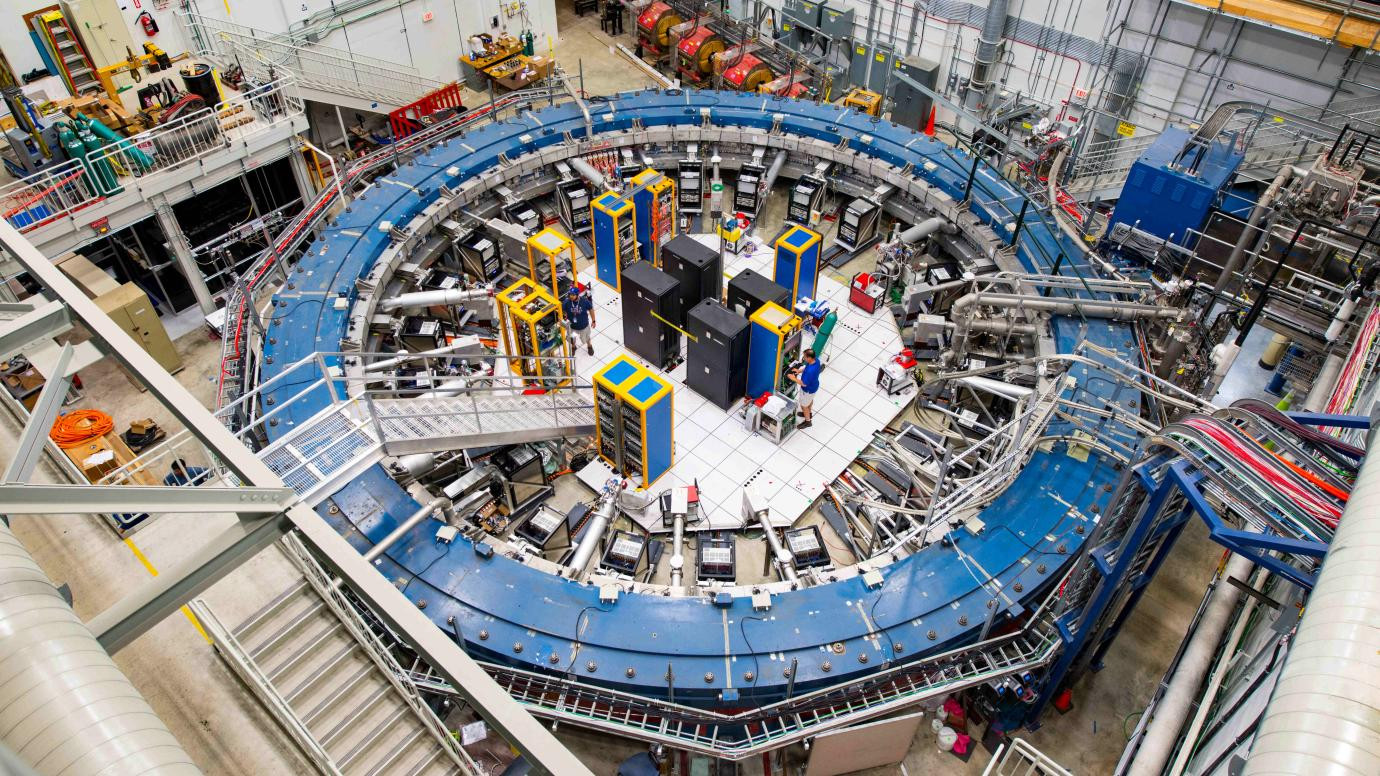
Researchers from Manchester are among the international team awarded the 2026 Breakthrough Prize in Fundamental Physics for their contributions to the Muon g鈥�2 experiment, a 60鈥憏ear scientific endeavour spanning CERN, Brookhaven National Laboratory and Fermilab. The prize follows Manchester鈥檚 prominent role in the 2025 Breakthrough Prize, awarded to the ATLAS and LHCb collaborations at CERN for precision tests of the Standard Model and discoveries including new particles and matter鈥揳ntimatter asymmetries.
Valued at $3 million, the Breakthrough Prize is often dubbed the 鈥淥scars of Science鈥� and is considered the world鈥檚 premier science award. Unlike the Nobel Prize, which recognises up to three individuals or a single organisation, the Breakthrough Prize honours the approximately 350 collaborators across the world who produced the most precise measurement ever achieved at a particle accelerator: the anomalous magnetic moment of the muon.
鈥淚t's wonderful that this award recognises the work of everyone who contributed to the measurement: PhD students, postdocs, engineers and Professors: science such as this, is only possible with a diversity of skills and talents. It鈥檚 been a great honour to work alongside so many talented people and to be a part of a measurement that will be in the textbooks for years to come鈥�
Understanding the muon鈥檚 magnetic moment
Muons, one of the smallest known particles, interact with a sea of virtual particles that constantly flicker in and out of existence. Acting like tiny magnets, their magnetic moment shifts slightly due to these quantum effects. Comparing the measured value with theoretical predictions reveals the composition of this quantum 鈥渇oam鈥� and tests whether unknown particles or forces exist beyond the Standard Model.
Decades of increasingly precise measurements now indicate that the Standard Model remains our best description of fundamental physics.
Manchester leadership across UK institutions
The UK played a central role in the collaboration, providing one of the experiment鈥檚 two major detector systems and in developing simulations and software to analyse the data alongside contributions to the theoretical calculations.
Professor Mark Lancaster, from The University of Manchester, led the UK involvement across Manchester, Lancaster, Liverpool and UCL, and served as co鈥憇pokesperson of the global Fermilab Muon g-2 collaboration between 2018 and 2020.
A global scientific milestone
The Muon g鈥�2 experiments began at CERN in the 1970s, moved to Brookhaven in the 1990s and concluded at Fermilab with the final publication in 2025. The goal was to measure the muon鈥檚 magnetic moment with ever鈥慽ncreasing precision, probing the quantum vacuum where virtual particles appear and vanish. Even the smallest deviation from theoretical predictions could point to new physics beyond the Standard Model.
The achievement represents the combined effort of scientists and engineers across multiple disciplines, reflecting the scale and diversity of expertise required to reach record鈥慴reaking precision.
With Manchester researchers again at the forefront of a globally celebrated breakthrough, the University continues to demonstrate its leadership in shaping the future of particle physics and advancing our understanding of the fundamental laws of nature.
Professor Mark Lancaster FRS said 鈥淥ur attention at Manchester now turns to a next generation of experiments that are striving to find evidence of new particles and interactions using novel quantum technologies鈥�