Large area MoSâ‚‚ reduces energy loss in magnetic memory films
Scientists at the University of Manchester have discovered that placing magnetic films on atomically thin molybdenum disulfide (MoS₂) fundamentally changes how they lose energy, a finding that could bring 2D‑material spintronics a step closer to real devices.
The team found that growing a widely used magnetic alloy, permalloy, on ultra‑thin MoS₂ alters the film’s internal crystal structure, changing how and where energy is lost as magnetic spins move. By separating energy losses that occur at the surface of the film from those arising within its internal structure, the researchers provide new design insights for devices that use two‑dimensional (2D) materials to control magnetism more efficiently.
Crucially, the work uses large‑area, manufacturing‑compatible MoS₂, showing that these effects are not confined to laboratory‑scale samples but are relevant for real, scalable spintronic technologies.
The study, published in , demonstrates that transition‑metal dichalcogenides (TMDs) can alter the fundamental properties of magnetic films. The results highlight the importance of careful comparison with control materials when assessing the impact of 2D layers on magnetic behaviour.
Spintronics is an alternative to conventional electronics that uses not only the charge of electrons, but also their spin, to store and process information. This approach underpins emerging technologies for magnetic memory and has potential applications in energy‑efficient, high‑speed computing. A major challenge in spintronics, however, is energy loss: as magnetic spins move, some energy is inevitably dissipated as heat, limiting device speed and efficiency.
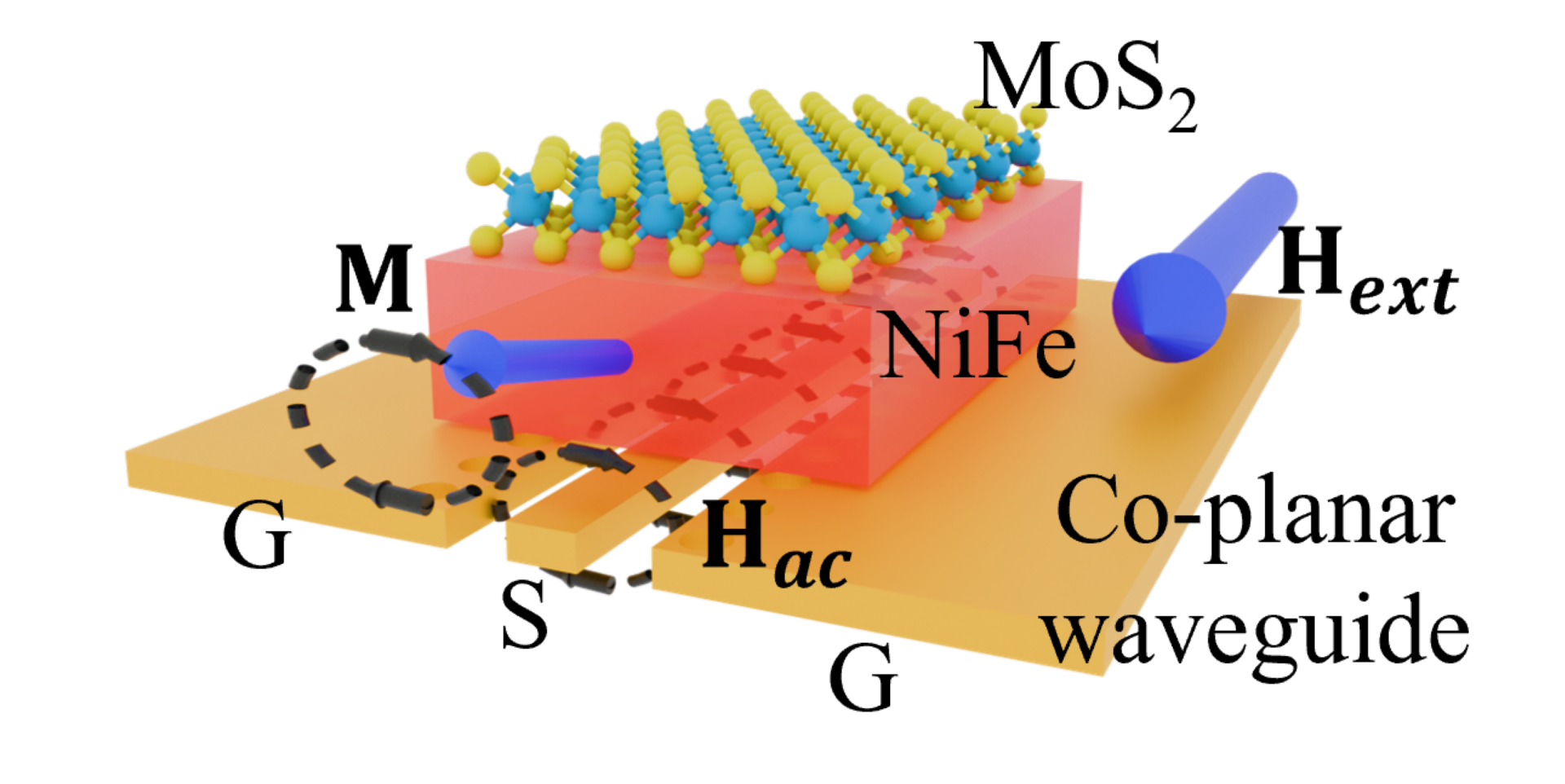
In this work, the researchers studied thin films of permalloy grown on top of large‑area MoS₂ produced using industry‑compatible chemical vapour deposition. They found that the ultra‑clean interface between permalloy and MoS₂ reduces energy loss at the surface of the magnetic film. At the same time, subtle changes within the film’s crystal structure slightly increase internal energy loss.
By clearly separating these two effects, the team was able to explain why previous studies of 2D materials and magnetism have sometimes produced conflicting results.
To reach these conclusions, the researchers used ferromagnetic resonance, a technique in which a high‑frequency magnetic field causes spins inside a magnetic material to wobble, similar to a spinning top slowing down due to friction. By measuring how quickly this wobble fades, the team could determine how and where energy is dissipated. Varying the thickness of the magnetic layer allowed them to distinguish losses occurring at the surface from those within the bulk of the film.
The results point to new routes for designing lower‑power, faster spintronic memory, where material interfaces are engineered to minimise unwanted energy loss without sacrificing performance.
“This work is exciting because the fundamental effects a two‑dimensional material can have on magnetic thin films are still largely unexplored,� said , lead author of the study and Research Associate in THz Spintronics at the University of Manchester. “We’ve shown how these changes affect energy loss, which is a crucial property for next‑generation memory technologies.�
The study shows that 2D materials do not always increase energy loss and that, with the right interface, they can reduce it.
This research was published in the journal .
Full title: Separation of bulk and surface contributions to the damping of permalloy on large-area chemical-vapor-deposited ²Ñ´Çâ�¢Sâ‚‚.
DOI:
The National Graphene Institute (NGI) is a world-leading graphene and 2D material centre, focussed on fundamental research. Based at The University of Manchester, where graphene was first isolated in 2004 by Professors Sir Andre Geim and Sir Kostya Novoselov, it is home to leaders in their field – a community of research specialists delivering transformative discovery. This expertise is matched by £13m leading-edge facilities, such as the largest class 5 and 6 cleanrooms in global academia, which gives the NGI the capabilities to advance underpinning industrial applications in key areas including: composites, functional membranes, energy, membranes for green hydrogen, ultra-high vacuum 2D materials, nanomedicine, 2D based printed electronics, and characterisation.